
- Home
- Why Clinamen
- Philosophy
- White paper
- The divider effect and SUT gain
- Total damping calibration to maximize tracking performance in MC cartridges
- Thinking beyond 47k: SUT primary loading and its effects on damping
- Clinamen Step-Up Transformer Theory
- IMA Amplifiers and Volume Control: Evolution of Audiophile Thought
- Philosophy of Physical Music Media
- Reviews
- Pricing Policy and Technical Support
- Contact


What does Calabi-Yau mean?
EXPLANATION OF THE DIFFUSER’S NAME
Eugenio Calabi and Shing-Tung Yau are two mathematicians (the former Italian) who studied and formalized the six-dimensional mathematical spaces known as Calabi-Yau spaces.
Their “practical” application emerged in string theory, a theory currently under investigation and not yet experimentally proven, which proposes that the most fundamental and smallest constituents of matter are made up of tiny vibrating strings.

Shing-Tung Yau and Eugenio Calabi
The natural modes of vibration of these strings would depend on the space in which they exist. Their vibrational modes would give rise to all the particles we know, as well as those that are currently unknown.
String theory (or, more precisely, superstring theory, since it predicts the existence of supersymmetry) is absolutely fascinating and scientifically interesting because it offers a way to resolve the greatest scientific conflict of our century: the incompatibility between Einstein’s General Relativity and Quantum Mechanics.
When we attempt to apply these two theories (both extensively validated within their respective domains) to very particular situations, such as a black hole, we encounter nonsensical results, with calculations yielding infinite values. This is because such situations require General Relativity to describe the extremely large masses involved, but also Quantum Mechanics to account for the extremely small scales involved.
String theory eliminates the concept of point-like matter, since strings have a finite size. Within this framework, Quantum Mechanics and General Relativity can coexist because string theory removes quantum fluctuations of the spacetime fabric at the scale of the Planck length.
String theory predicts that the Universe around us consists of three extended spatial dimensions (the ones we know), one time dimension, and six compactified spatial dimensions.
Compactified means that these dimensions are extremely small and curled up on themselves (Planck length: 10⁻³³ cm). For this reason, they would be invisible both to our senses and to our instruments.
It has been proposed that the geometry of these six compactified dimensions could correspond to a Calabi-Yau manifold.
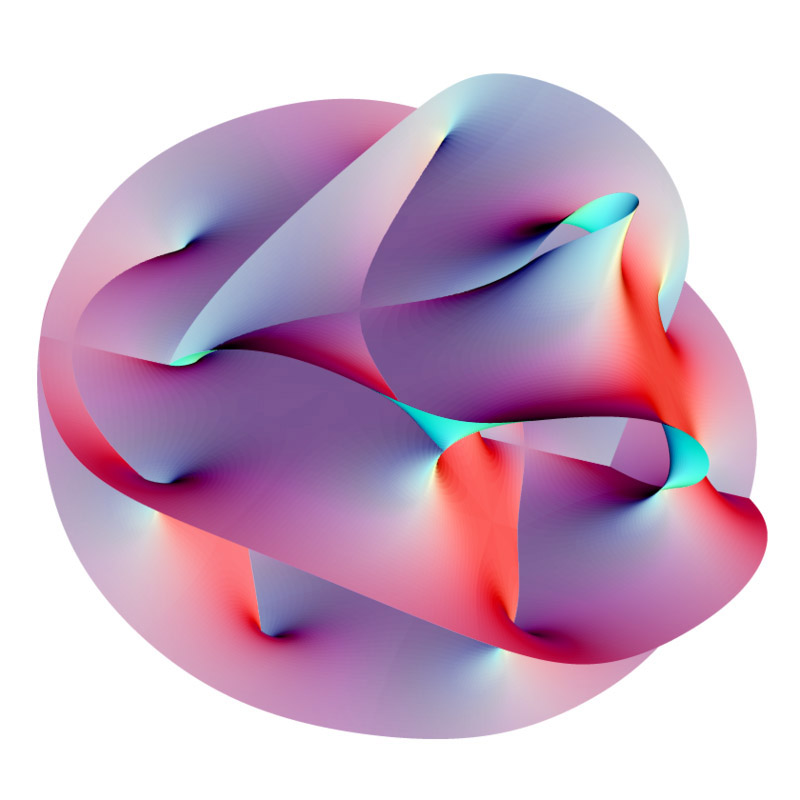
Superficie matematica di Calabi-Yau 6-dimensionale
String theory also addresses another major question: why do the fundamental constants of our Universe (the masses of the various particles, their electric charges, their spins, and so on) have precisely the values they do, rather than different ones?
After all, it is precisely the delicate balance between these various constants that makes life and matter, as we know them, possible. At present, nobody knows the answer.
String theory, however, may offer a way to find it. As we have seen, particles themselves, as well as force carriers, are manifestations of the way a string vibrates, and its vibration depends on the space in which it vibrates.
We now know with a high degree of confidence that the spaces in which strings vibrate are Calabi-Yau spaces. However, there are many thousands of possible Calabi-Yau manifolds, and at present we are unable either to select the correct space from this family or to calculate the vibrational frequencies of the strings.
The mathematics involved is extremely complex, but if one day we succeed in calculating these frequencies, we should be able to reproduce all the particles in our Universe (electrons, taus, muons, bosons, quarks, and so on) and predict the existence of those that have not yet been discovered.
Another extremely fascinating aspect of superstring theory is that it predicts the existence of massless particles with spin = 2, which is precisely the defining property of the graviton, the hypothetical particle that carries the gravitational force.
I apologize for any inaccuracies in this brief account, but I have tried to summarize an extremely complex subject using only what I can remember. The above should not be regarded as a scientifically rigorous account.
Clinamenaudio • Dott. Ing. Stefano Buttafoco
Contrada Barattelli 3A
San Benedetto del Tronto (AP) 63074
C.F.: BTTSFN74M01H769L / P.IVA: 02123590446
Registro AEE : IT20070000012328
Update cookie preferences
Tel. cellulare (+39) 340 8756612
Tel. laboratorio (+39) 0735 782043
E-mail: info@clinamenaudio.com
Instagram  :https://instagram.com/clinamenaudio