
- Home
- Why Clinamen
- Philosophy
- White paper
- The divider effect and SUT gain
- Total damping calibration to maximize tracking performance in MC cartridges
- Thinking beyond 47k: SUT primary loading and its effects on damping
- Clinamen Step-Up Transformer Theory
- IMA Amplifiers and Volume Control: Evolution of Audiophile Thought
- Philosophy of Physical Music Media
- Reviews
- Pricing Policy and Technical Support
- Contact

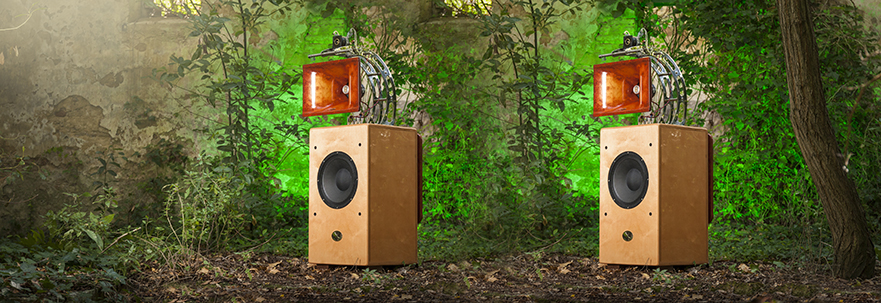
Chronological History from SN1 to SN5
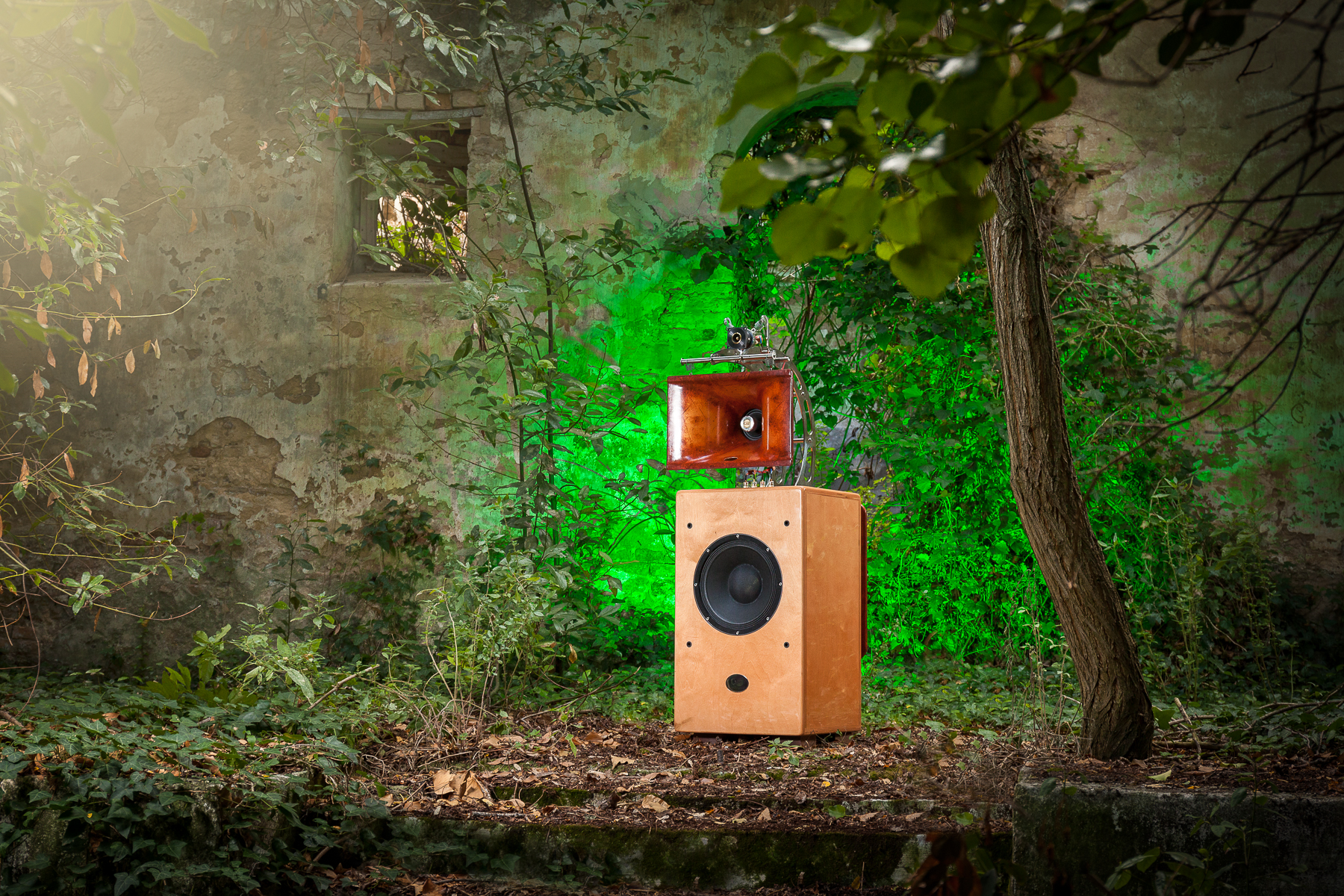
Calabi-Yau (CY) is a project born from the experience and insights gained while developing the Kamala loudspeaker, of which only one pair was built.
The first Calabi-Yau prototype was started around mid-2015. Since then, the design has undergone continuous development and refinement. As of May 2024, four pairs have been built, with a fifth under construction.
This does not mean that the earlier models were not optimized. Rather, the almost utopian pursuit of perfection, inherent in the human spirit, drives me to continually improve both the aesthetic and, above all, the functional aspects of the design.
The earlier models can also benefit from substantial retrofits, incorporating many of the innovations introduced in subsequent versions. The purpose of this page is to provide an overview of the evolutionary journey of the various models.
CY SN1
This is the loudspeaker on which the initial experiments and listening tests were conducted, marking the beginning of the Calabi-Yau project. It was originally designed as a two-way system, featuring a matte red lacquered MDF enclosure housing a 12-inch EMS woofer. This same woofer has been retained throughout every subsequent version, right up to the current SN5.
The 5-inch full-range driver, also manufactured by EMS and custom-built for my company, is an outstanding ferrite-magnet unit featuring a Faraday ring in the magnetic gap and a single-cone design. In free air, its response extends up to 16–18 kHz. Within the waveguide, physical constraints limit its response to approximately 13 kHz. However, with a carefully designed crossover, the upper-frequency extension reaches approximately 15 kHz (-3 dB).
The waveguide (WG) is made of plywood, featuring a golden-ratio mouth profile and a natural wood finish. Its cutoff frequency is 300 Hz, with an electrical crossover point around 600 Hz. A distinctive feature is the Helmholtz resonator opening into its throat, designed to smooth the response over the first octave of its operating range. It can be disabled by sealing its neck with a carbon-fiber plate.
The Helmholtz resonator was abandoned in subsequent versions. The response peak in the lower operating range of the waveguide was instead addressed through electrical methods in the SN2 and SN4, and acoustic methods in the SN3 and SN5.
The waveguide is suspended on a spring system that isolates it from vibrations originating in the main enclosure. Its support structure, made from threaded rods, is rather rudimentary but fully functional.
The woofer already features the TDR (Tuned Distributed Reflex) alignment, with a port that slides along threaded rods, allowing the enclosure tuning frequency (Fb) to be adjusted.
The midrange crossover does not feature inductive adjustment. Instead, it uses a passive circuit to recover energy lost through high-frequency attenuation, thereby extending the driver's response into the upper treble.
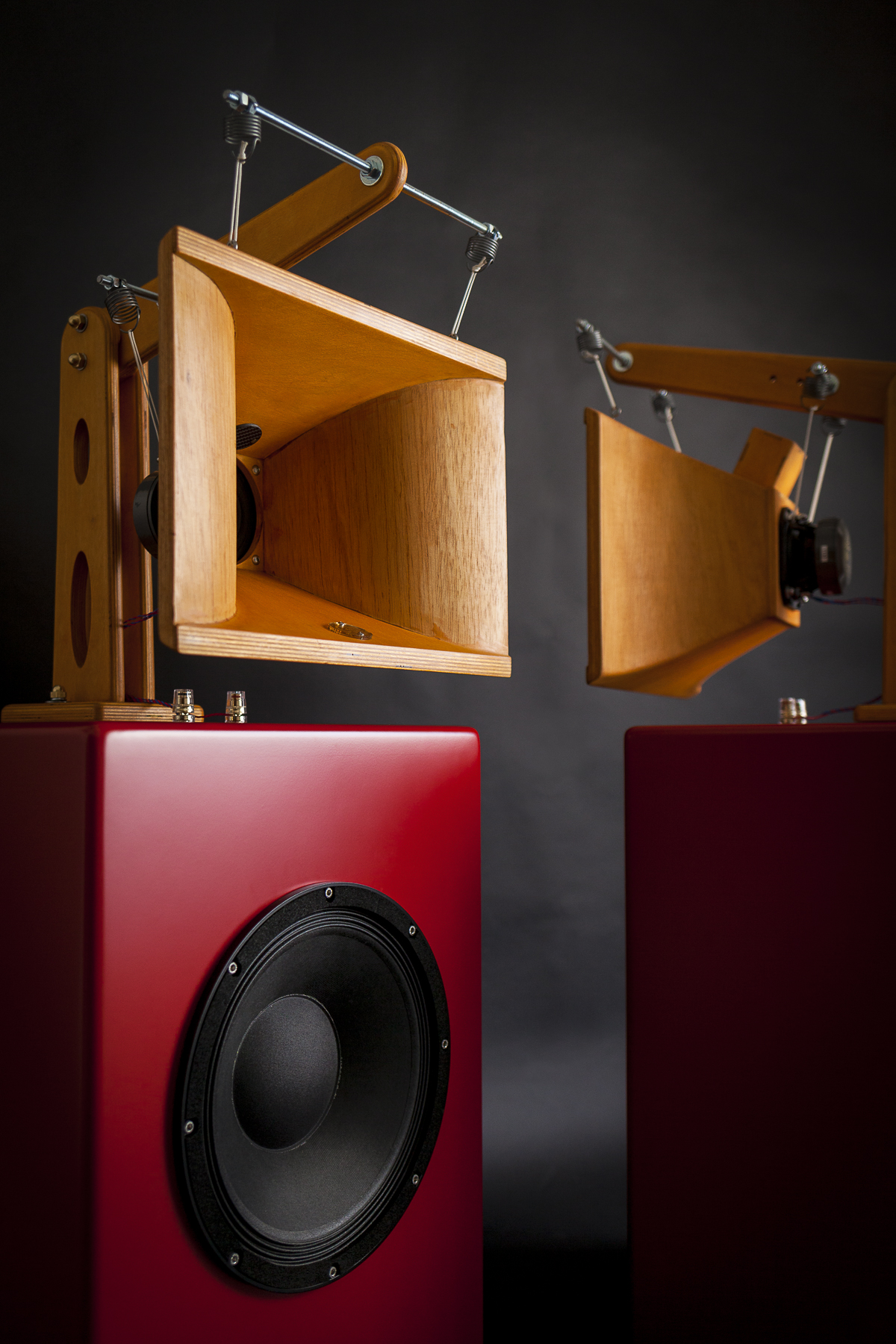
The first Calabi-Yau, built in 2015: SN1. It is the only two-way version among all the models produced.
CY SN2 & SN3
The major change from the SN1 was the transition to a three-way configuration, incorporating the Fostex FT96H tweeter, an outstanding 100 dB/W/m component.
The waveguide's operating range was consequently narrowed to 500–12,000 Hz. The upper frequencies, where pronounced cone break-up occurs, are mechanically suppressed by a phase plug fitted in the waveguide throat, produced using rapid prototyping.
The crossover remains simple in topology but sophisticated in implementation. Both midrange and tweeter attenuation are achieved through an inductive system using proprietary transformers. Each driver can be adjusted across five levels, in 1 dB increments, using jumper links on a panel at the base of the loudspeaker.
The SN1 features a walnut-finished enclosure and an oxidized bronze finish on the horn.
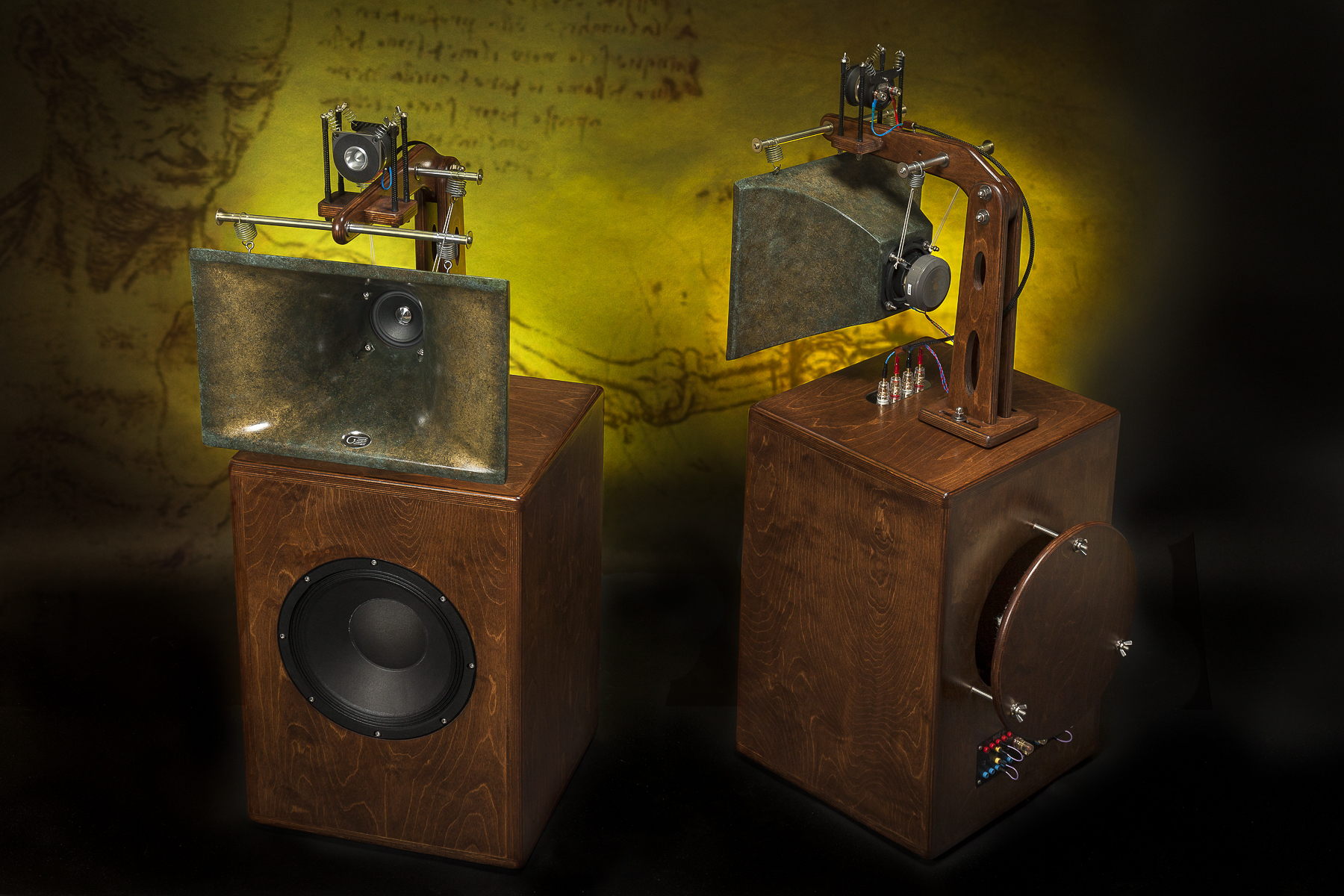
Calabi-Yau SN2 — walnut / oxidized bronze
The SN3 features a pearl-white lacquer finish on the enclosure and upper structures, while the waveguide and tuning panel have a Portoro marble-effect finish.
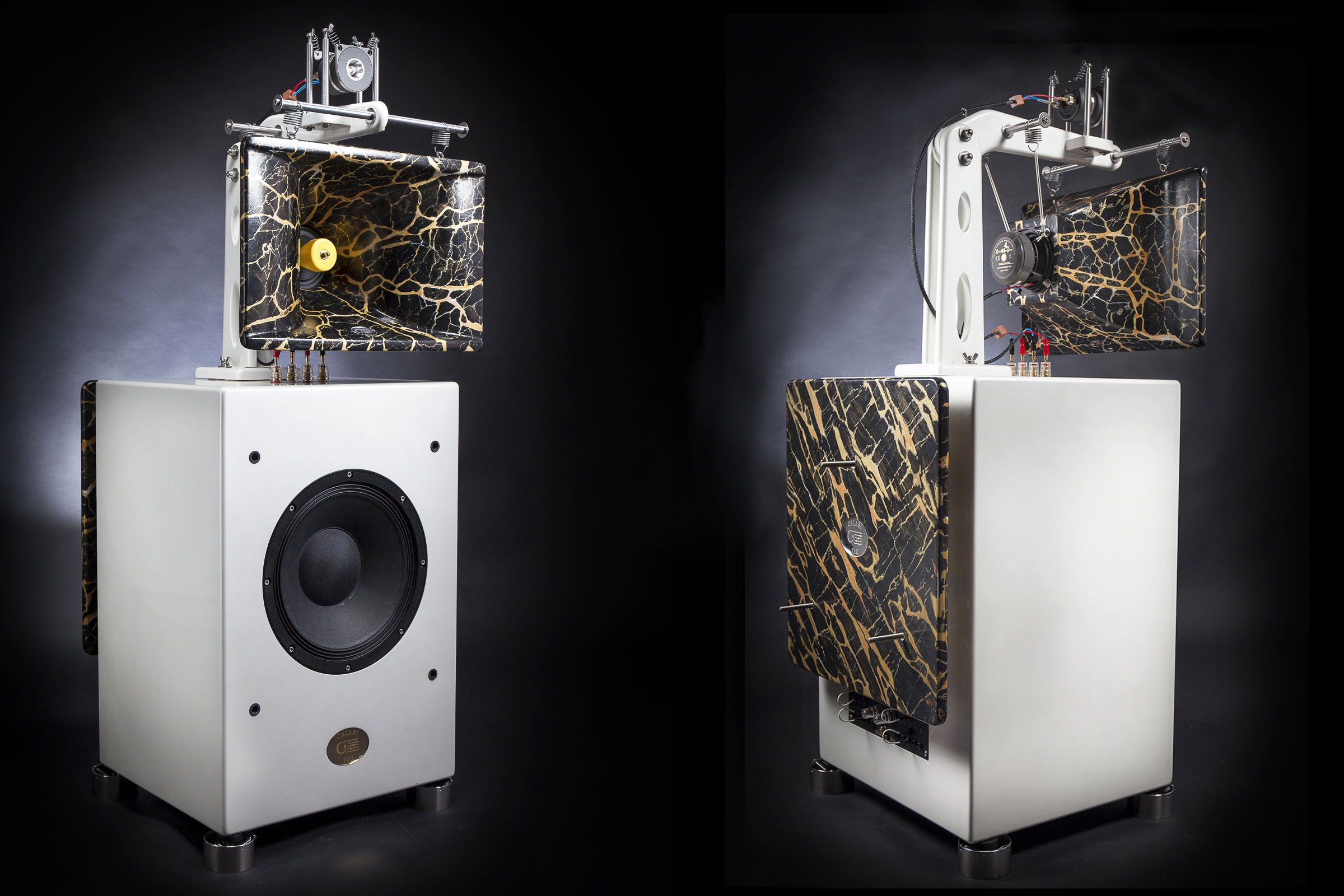
Calabi-Yau SN3 — pearl white / Portoro marble (before the three retrofits)
Between November 2023 and April 2024, the CY SN3 underwent an intensive retrofit that raised its performance to a level that, at the time, made it the most advanced of the entire CY family, including the subsequent SN4, which, when this was written, had received only the midrange retrofit.
The CY SN3 was fitted with a mechanical filter on the woofer, allowing its electrical filter section to be dramatically simplified. This largely isolates the driver from the energy rebounds occurring between the reactive elements of the crossover, which are now reduced to just one. The midrange was replaced with a new 4-inch driver featuring 15% higher magnetic flux density in the gap, a cone treated with luthier's lacquer and a new technical-paper voice former.
Several key crossover components were also upgraded, most notably the woofer filter inductor, now using an ultra-low-series-resistance core with fully confined magnetic flux, and the midrange attenuation, no longer handled by an attenuating transformer but by a larger-core autotransformer. The tweeter crossover point was lowered to 8 kHz for greater coherence and smoother dispersion through the crossover region. A new yellow-anodized Ergal phase plug was added to the midrange, along with new stainless-steel badges throughout the loudspeaker and a retuned enclosure alignment with a longer port.
In October 2025, the CY SN3 received a second major retrofit, both aesthetic and functional. The golden-ratio AISI 304 support arm introduced with the SN4 was adopted, while the beautiful limited-edition Fostex T96A-EX2 tweeter, previously used in the SN4, replaced the original tweeter. This time, however, the tweeters received a machined front flange for greater visual coherence. They are not mounted on a panel, but suspended by a spring system with a custom yellow-anodized Ergal clamp.
At the beginning of 2026, I focused on further refining the enclosure alignment, building on experiments related to one of my main design principles: energy storage and its subsequent out-of-phase release. I address this phenomenon in both electronics and loudspeakers under the concept of Zero Storage.
The TDR (Tuned Distributed Reflex) alignment was therefore transformed into a damped Zero Storage alignment, virtually eliminating the internal air resonance of the enclosure through acoustic resistance. This type of aperiodic alignment, with a radial 360-degree output, produces an almost perfectly flat impedance magnitude because the enclosure tuning frequency effectively disappears. The acoustic transient response is exceptionally fast, with virtually no residual ringing.
This proprietary Clinamen alignment is called ZSRL (Zero Storage Radial Loading). The radial outlet is formed by a beautiful, thick transparent methacrylate panel.
As of October 2026, the CY SN3 incorporating these retrofits — mechanical woofer filter, ZSRL alignment, golden-ratio AISI 304 support arm, T96A-EX2 tweeter, new crossover with Zero DCR inductors, new midrange driver and associated upgrades — is available for listening at the Atelier and for purchase. The price is €20,000 per pair.
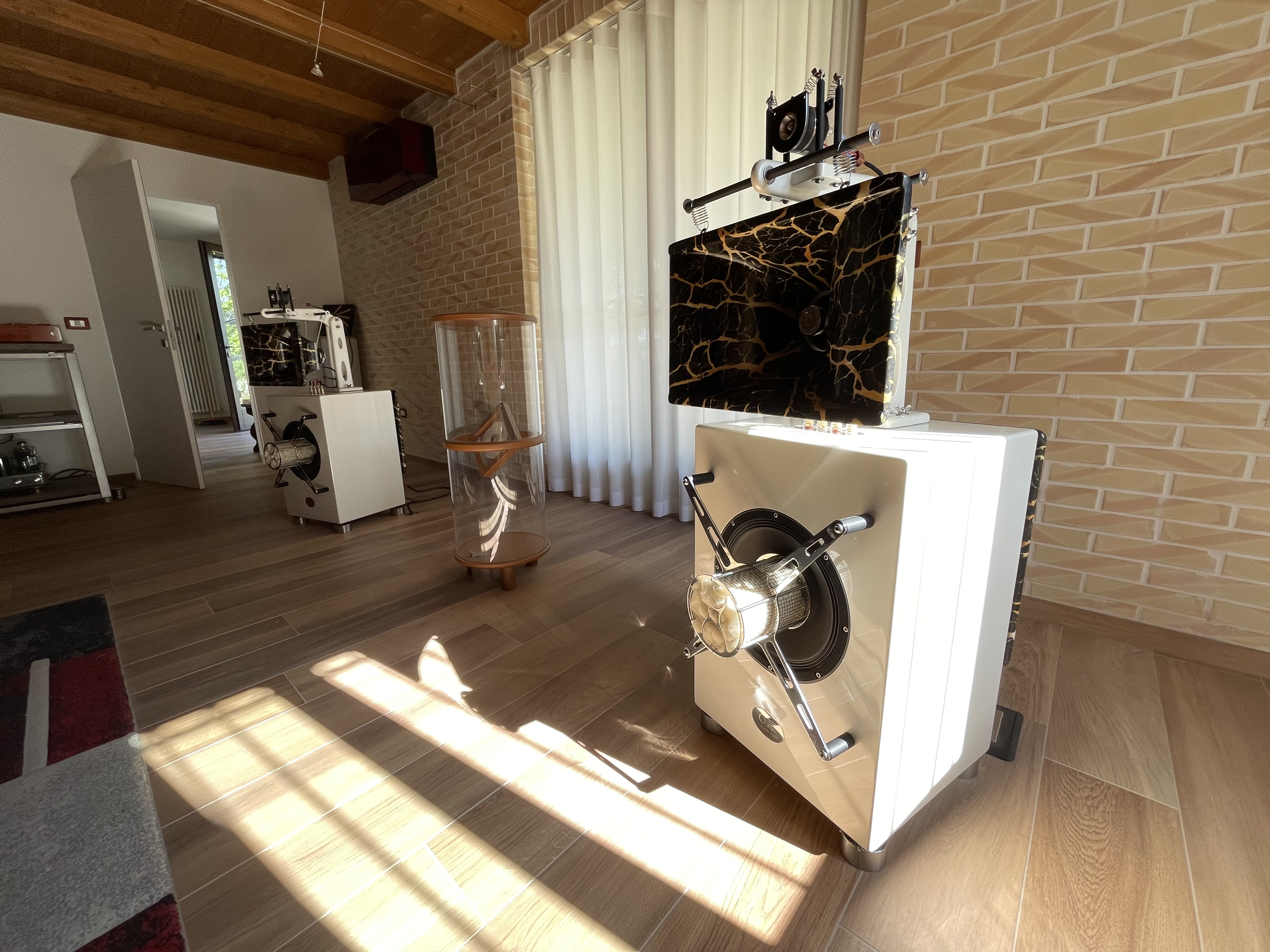
Calabi-Yau SN3 with the first 2023/2024 retrofit only
CY SN4
The CY SN4 introduced numerous aesthetic and functional improvements. The enclosure volume was increased by approximately 10 liters, lowering its natural tuning frequency (Fb) and consequently extending its low-frequency response.
Calabi-Yau SN4 — glossy stained birch / oxidized copper
The arms supporting the waveguides and tweeter are no longer made of lacquered wood, but from 5 mm AISI 304 stainless steel, shaped according to the golden ratio and mirror-polished. The tweeter is mounted in a dedicated solid-machined retaining flange, attached to the main structure by custom “F”-shaped brackets.
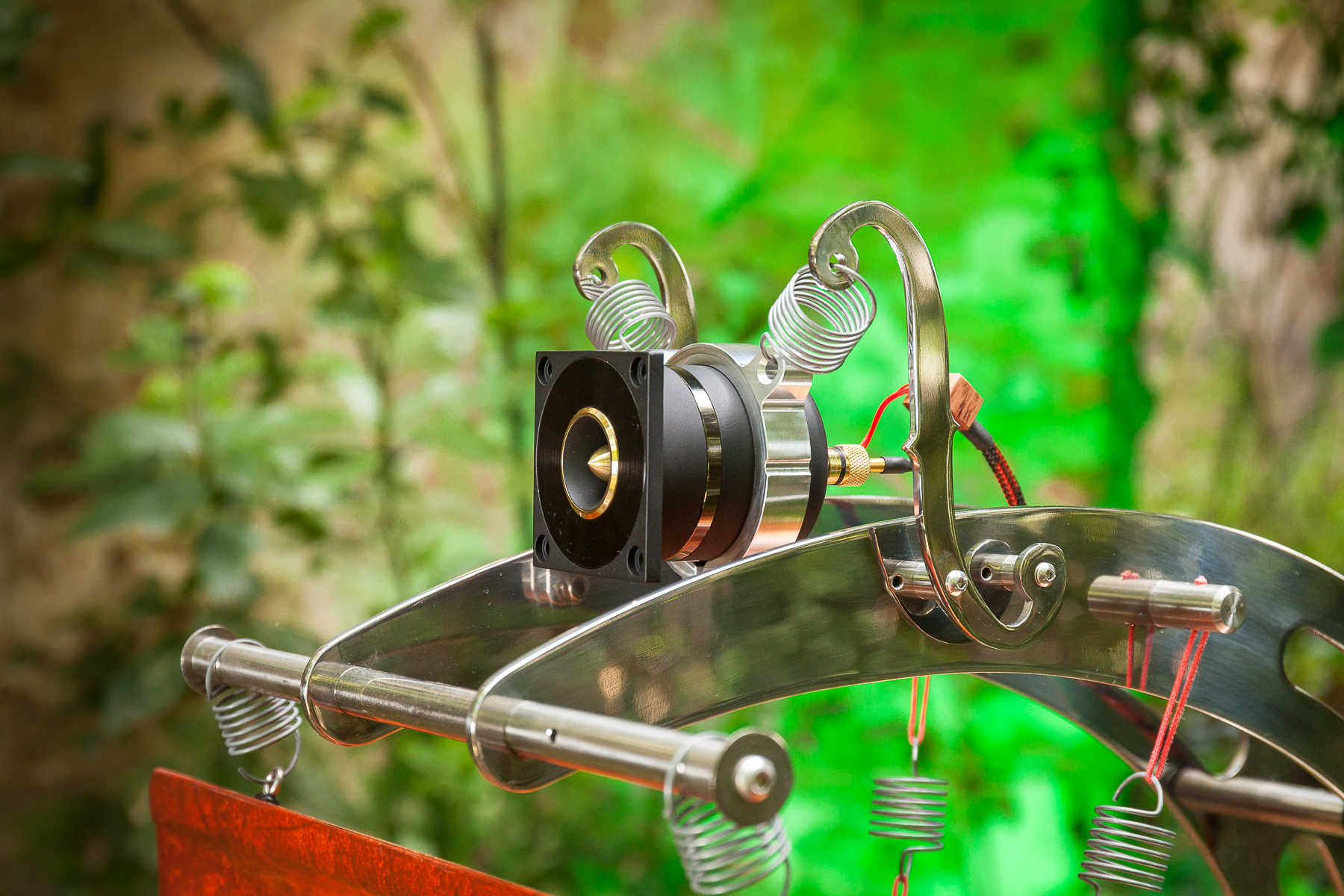
The rear tuning ports are adjustable using the supplied spacers. Two spacer sizes can be combined to provide three discrete tuning options. I abandoned the previous system, in which a panel could be continuously adjusted along three threaded studs, in favor of greater structural rigidity and a cleaner appearance.
The crossover features substantial component upgrades, particularly in the woofer low-pass section, where the equivalent series resistance of the inductor has been reduced, resulting in lower losses and improved articulation and sensitivity in the bass region.
The midrange phase plugs are now machined from solid Ergal rather than rapid-prototyped polymer, and feature the Clinamen logo on their front face. All badges and logos on the loudspeaker are now made from mirror-polished, laser-marked stainless steel, replacing the previous ABS components.
A new custom laser-cut gasket made from special paper is used between the woofer and enclosure. This component is crucial for achieving the correct vibrational coupling between the woofer and the cabinet, and therefore for the final acoustic performance.
For the tweeter, Fostex had discontinued the FT96H, which I had used with great satisfaction. I therefore chose another model from the Japanese manufacturer, the T96A-EX2, a limited-edition special model. Compared with the FT96H, it offers 1 dB higher sensitivity, a bronze horn and phase plug, an enlarged magnet, a tungsten damper in contact with the periphery of the voice coil, a copper-plated pole piece and silver-plated internal wiring. It is a highly refined design, sold at a considerably higher price than the FT96H. In listening, the T96A-EX2 offers an even more refined performance, with greater delicacy and finesse, and an enhanced ability to recreate the soundstage and acoustic ambience.
CY SN5
The SN5 is currently under construction. It retains the same approximately 100-liter enclosure as the SN4, but incorporates a front-mounted mechanical filter on the woofer and, naturally, the new ZSRL alignment introduced in 2026 on the retrofitted CY SN3.
The midrange is the custom driver developed for the retrofitted SN3, featuring 15% higher magnetic flux density, a cone treated with luthier's lacquer and a technical-paper voice former. The SN5 will incorporate all the major developments introduced with the SN3 retrofit, including the new woofer filter inductor, with extremely low parasitic resistance and fully confined magnetic flux. The midrange autotransformer will go a step further, using a custom model with a larger nanocrystalline core.
All these developments will bring the Calabi-Yau project to the highest level of its evolutionary development.
The price is €22,500 per pair. Pre-orders are accepted, allowing the customer to personalize the finish and colors of both the enclosure and the waveguide.
Clinamenaudio • Dott. Ing. Stefano Buttafoco
Contrada Barattelli 3A
San Benedetto del Tronto (AP) 63074
C.F.: BTTSFN74M01H769L / P.IVA: 02123590446
Registro AEE : IT20070000012328
Update cookie preferences
Tel. cellulare (+39) 340 8756612
Tel. laboratorio (+39) 0735 782043
E-mail: info@clinamenaudio.com
Instagram  :https://instagram.com/clinamenaudio